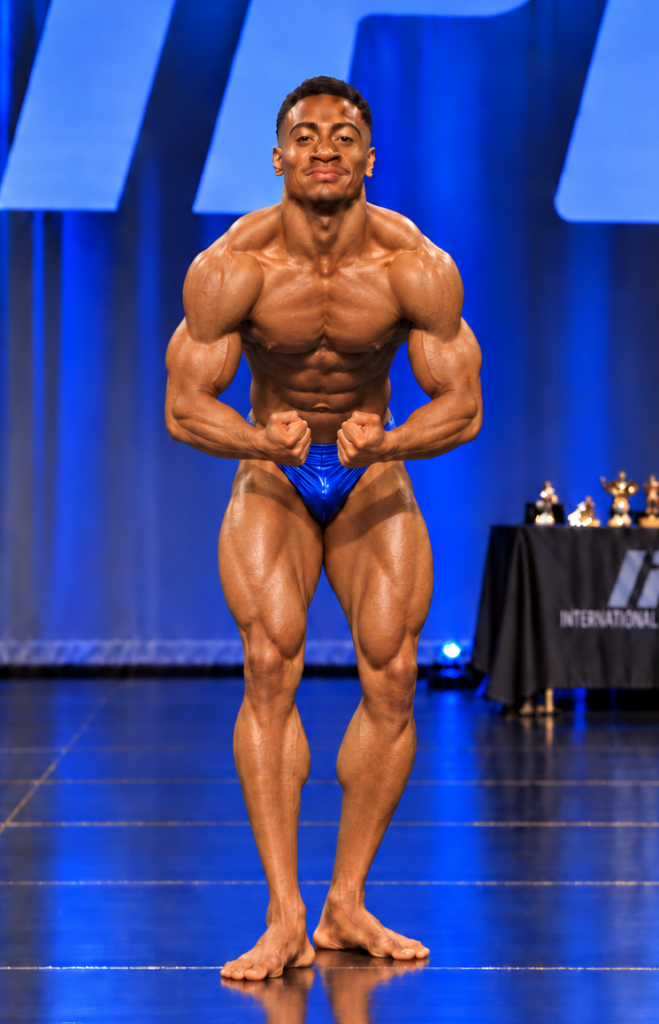
After each quarter turn, athletes should hold the appropriate relaxed pose and wait for the Head Judge to call specific poses. Athletes should not automatically begin performing additional poses. Performing uncalled poses may result in point deductions.
Athletes should be prepared to perform all listed poses, although the Head Judge may not request every pose. This includes all three Most Muscular variations.
Poses should clearly display muscularity, conditioning, symmetry, and a confident, controlled presentation.
Athletes will move through Front, First Side, Back, Second Side, and return to Front.
The mandatory poses are:
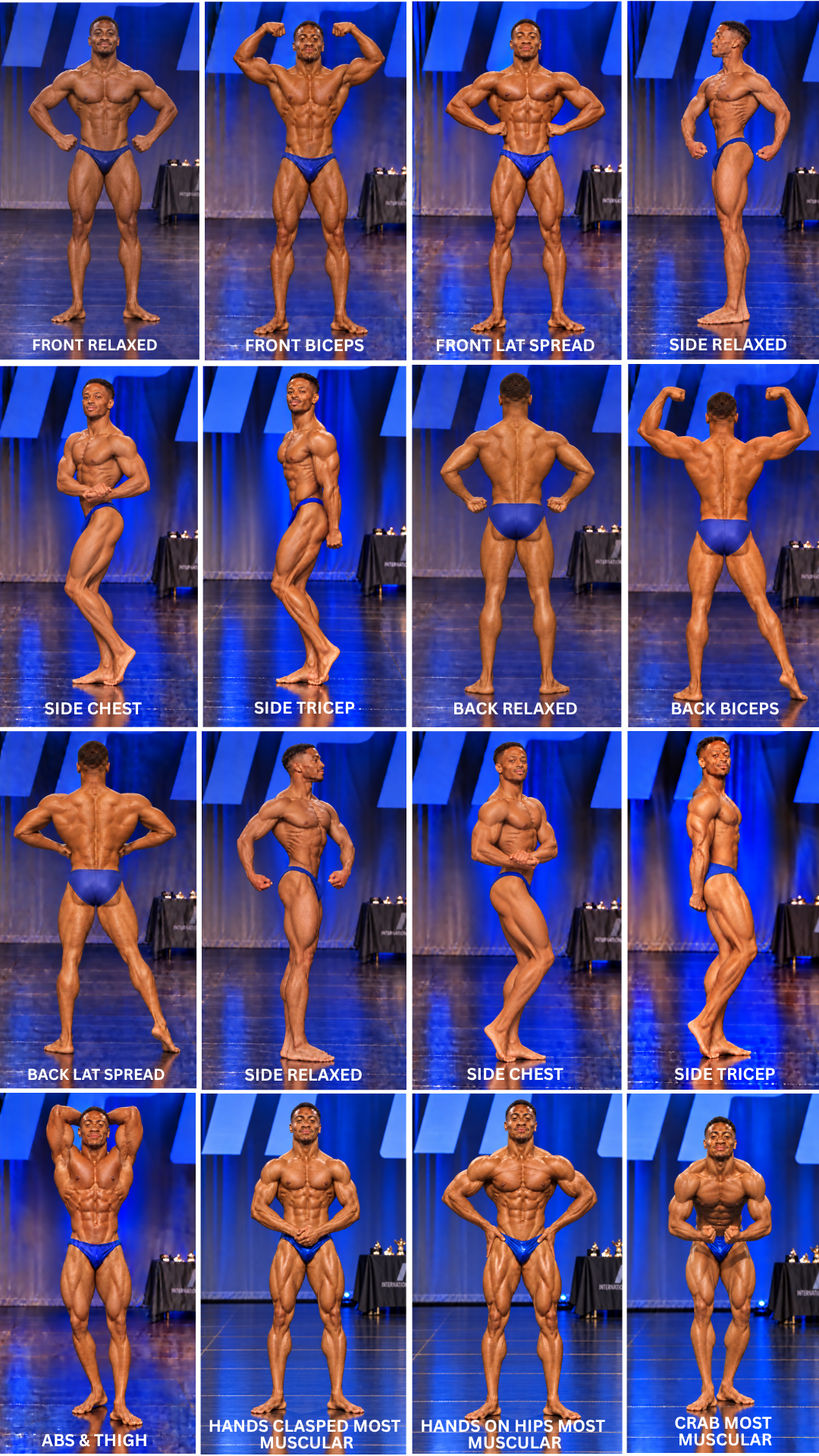
Front Relaxed
Front Biceps
Front Lat Spread
First Side Relaxed
First Side Chest
First Side Tricep
Back Relaxed
Back Biceps
Back Lat Spread
Second Side Relaxed
Second Side Chest
Second Side Tricep
Abs & Thigh
Hands Clasped Most Muscular
Hands on Hips Most Muscular
Crab Most Muscular
FRONT RELAXED
The athlete should face the judges directly, with the body and hips square to the front.
Both arms should be held slightly away from the torso, with the elbows bent outward and the hands closed near the waist, as demonstrated in the official posing image.
Both feet should remain flat on the floor and approximately shoulder width apart.
The athlete should maintain an upright posture while presenting the physique.
FRONT BICEPS
From the Front Relaxed position, the athlete should raise both arms into the Front Biceps pose.
The upper arms should extend outward, with the elbows bent and positioned slightly above shoulder level.
Both hands should be closed into fists.
The torso and hips should remain square to the judges, with the abdominal muscles and legs engaged.
The feet should remain planted and spaced apart as demonstrated in the official posing image.
From the Front position, the athlete should position both hands against the sides of the waist.
The elbows should move outward as the athlete expands the lats to display upper-body width.
The shoulders should remain controlled, with the chest lifted and the torso facing directly toward the judges.
Both feet should remain flat on the floor, with the legs engaged.
FIRST SIDE RELAXED
Quarter turn to the athlete’s right.
The athlete should present the side of the physique while keeping the upper body open enough for the judges to clearly evaluate.
Both elbows should be bent, with the hands closed and held near the waist as demonstrated in the official posing image.
The arms should be positioned so the presentation shoulder, arm, and elbow closest to the judges remain clearly visible.
The legs should remain relatively straight, with the feet positioned close together and flat on the floor.
The athlete should not turn their head toward the judges.
FIRST SIDE CHEST
From the Side Relaxed position, transition into the Side Chest pose.
The arm closest to the judges should bend across the front of the torso, with the opposite hand securing the wrist or hand to establish the pose.
The chest should be lifted and presented toward the judges while maintaining the side orientation of the lower body.
Both knees should bend, with the legs pressed together to display thigh development.
The foot closest to the judges should have the heel raised as demonstrated in the official posing image.
The athlete should look toward the judges in this pose.
FIRST SIDE TRICEP
From the Side Relaxed position, transition into the Side Tricep pose.
The arm closest to the judges should extend downward alongside the body to display the triceps.
The opposite arm should reach behind the torso, with the hand securing the presentation hand or wrist to establish the pose.
Both knees should bend, with the legs pressed together to display thigh development.
The foot closest to the judges should have the heel raised as demonstrated in the official posing image.
The athlete should look toward the judges in this pose.
BACK RELAXED
Quarter turn to the athlete’s right.
The athlete should face directly away from the judges, with the back and hips square to the rear.
Both elbows should be bent outward, with the hands closed and held low near the waist.
Both feet should remain flat on the floor and approximately shoulder width apart.
The athlete should maintain an upright posture that clearly displays the back, shoulders, waist, glutes, and legs.
BACK BICEPS
From the Back Relaxed position, the athlete should raise both arms into the Back Biceps pose.
The upper arms should extend outward, with the elbows bent and positioned slightly above shoulder level.
Both hands should be closed into fists.
One leg should remain planted under the body. The opposite leg should extend diagonally backward and outward, with the heel raised to display the calf, as demonstrated in the official posing image.
The athlete should engage the back, shoulders, arms, glutes, hamstrings, and calves while maintaining a controlled posture.
BACK LAT SPREAD
From the Back Relaxed position, the athlete should position both hands against the sides of the waist.
The elbows should be held outward and raised sufficiently to display the width of the lats, as demonstrated in the official posing image.
The back and hips should remain square to the judges.
One leg should remain planted under the body. The opposite leg should extend diagonally backward and outward, with the heel raised to display the calf.
The athlete should clearly present back width and lower-body development while maintaining balance and control.
SECOND SIDE RELAXED
Quarter turn to the athlete’s right.
The Second Side Relaxed position should mirror the First Side Relaxed position, presenting the opposite side of the physique to the judges.
Both elbows should be bent, with the hands closed and held near the waist.
The presentation shoulder, arm, and elbow closest to the judges should remain clearly visible.
The legs should remain relatively straight, with the feet positioned close together and flat on the floor.
The athlete’s head should not be turned toward the judges.
SECOND SIDE CHEST
From the Side Relaxed position, the athlete should transition into the Side Chest pose.
The Second Side Chest should mirror the First Side Chest pose from the opposite side.
The arm closest to the judges should bend across the front of the torso, with the opposite hand securing the wrist or hand.
The chest should be lifted and presented toward the judges.
Both knees should bend, with the legs pressed together to display thigh development.
The foot closest to the judges should have the heel raised as demonstrated in the official posing image.
The athlete should look toward the judges in this pose.
SECOND SIDE TRICEP
From the Side Relaxed position, the athlete should transition into the Side Tricep pose.
The Second Side Tricep should mirror the First Side Tricep pose from the opposite side.
The arm closest to the judges should extend downward alongside the body. The opposite hand should reach behind the torso and secure the presentation hand or wrist.
Both knees should bend, with the legs pressed together to display thigh development.
The foot closest to the judges should have the heel raised as demonstrated in the official posing image.
The torso should remain upright and controlled.
The athlete should look toward the judges in this pose.
ABS & THIGH
Quarter turn to the athlete’s right, returning to the front.
Both hands should be positioned behind the head, with the elbows open outward.
One leg should remain under the body as the supporting leg. The opposite leg should be positioned slightly forward, with the thigh engaged and clearly presented to the judges.
The athlete should contract the abdominal muscles while displaying thigh definition.
The positioning should closely follow the official Abs & Thigh posing image.
HANDS CLASPED MOST MUSCULAR
The athlete should lower the arms and bring both hands together at the center of the body, just above the waistband.
The hands should form a compact clasp.
The elbows should remain bent and held outward while the athlete contracts the chest, shoulders, arms, and abdominal muscles.
The torso should remain upright, with both feet planted and the legs engaged.
Both feet should remain planted, with the legs engaged as demonstrated in the official posing image.
HANDS ON HIPS MOST MUSCULAR
The athlete should place both hands on the hips.
The elbows should remain bent and extend outward.
The athlete should contract the chest, shoulders, arms, and abdominal muscles while keeping the torso upright and facing the judges.
Both feet should remain planted, with the legs engaged as demonstrated in the official posing image.
CRAB MOST MUSCULAR
The athlete should lean slightly forward and bring both arms in front of the torso.
Both elbows should remain bent, with the hands closed into separate fists and held close together in front of the midsection.
The hands should remain separate rather than clasped.
The athlete should contract the shoulders, chest, arms, traps, and abdominal muscles while maintaining a stable lower-body position.
The amount of forward lean and the arm positioning should closely follow the official Crab Most Muscular posing image.
During the Crab Most Muscular Pose one foot should be placed slightly or moderately more forward that the other, with the legs engaged as demonstrated in the official posing image.
OVERALL PRESENTATION
Men’s Bodybuilding posing should demonstrate muscular development, conditioning, symmetry, control, and confidence.
The official IPL Men’s Bodybuilding posing images are the standard for the mandatory poses. Athletes should practice and execute each pose as demonstrated rather than substantially modifying the positioning or substituting alternative poses.
Transitions between poses should be controlled and deliberate, with the athlete maintaining presentation throughout each quarter turn.