
EVENING GOWN POSING & GUIDELINES
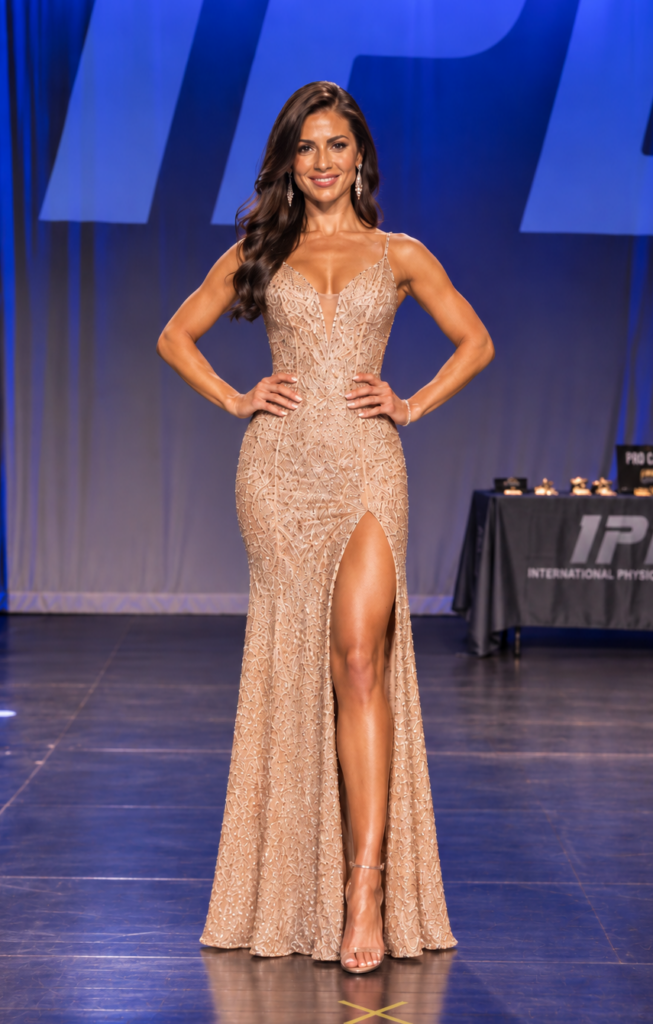
Guidelines
Gown should be revealing, yet tasteful.
Gown should complement, highlight, and showcase feminine musculature at its best.
Gown must be a one-piece. Skirt bottom with separate top not permitted.
At least one arm and one shoulder must be fully exposed.
At least one leg must be exposed/showcased through a slit. The slit must be on the left side of the gown. Right-side slits and double-slit gowns are not permitted.
Minimum 50% of the back must be exposed.
Gown must extend to the ankles or lower. Maximum 6-inch train.
Stones are optional, not required.
Jewelry and hair ornaments are allowed at Pre-Judging and Finals.
Presentation, including make-up and hair, is judged.
Clear Competition Heels. With or without stones. (no minimum or maximum heel height)
Posing
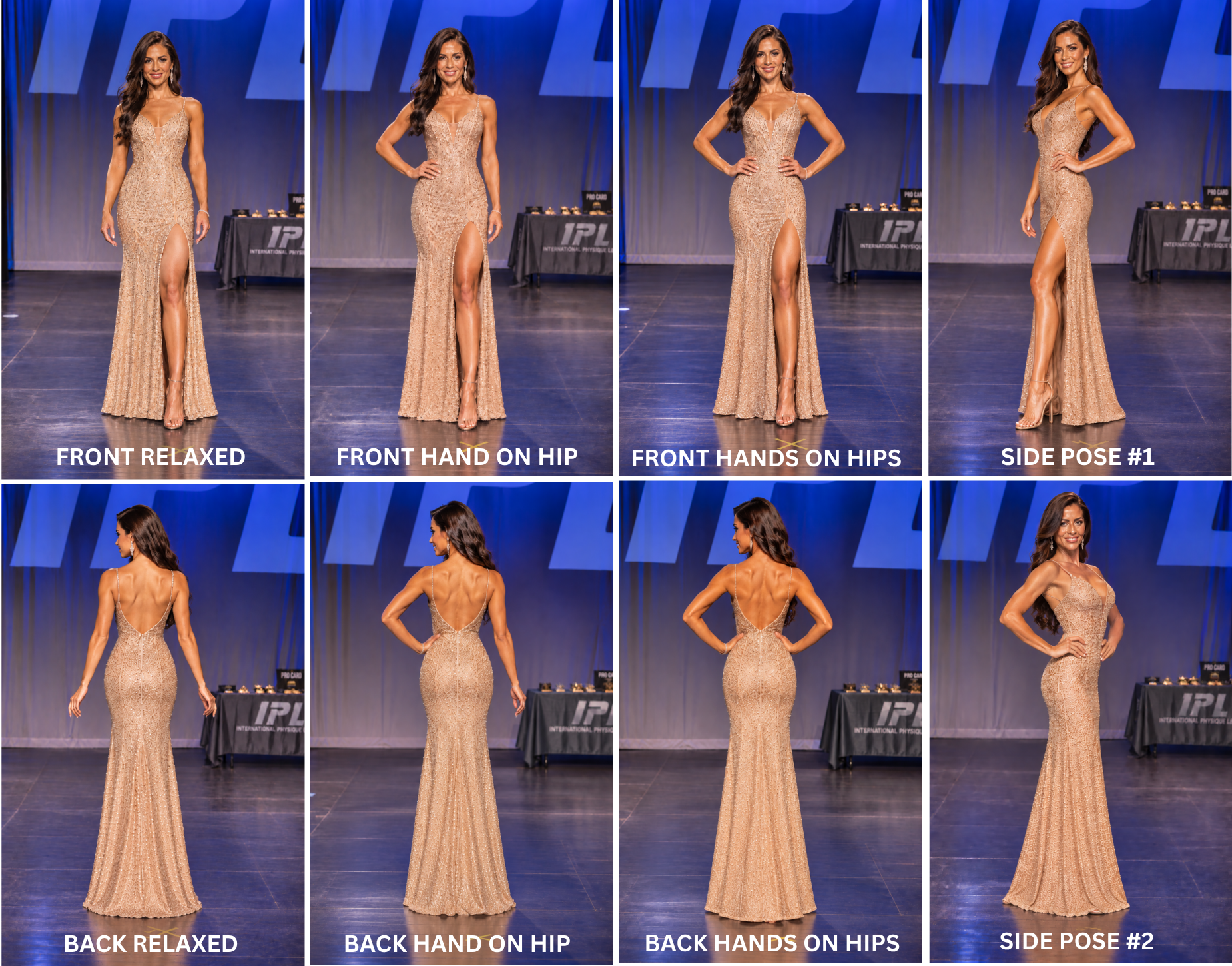
GENERAL POSING
Evening Gown posing should appear elegant, poised, confident, and natural.
Athletes will move through four positions: Front, First Side, Back, and Second Side.
The Front and Back positions each have a designated relaxed pose. During comparisons, the Head Judge may call for additional mandatory hand positions at their discretion.
Movements between poses should be smooth, controlled, and elegant.
FRONT POSE
The athlete should face the judges directly, with the body and hips generally square to the front.
Front Relaxed is the standard Front Pose. Both arms should hang naturally and comfortably at the sides.
The left leg, which is the official slit side, may be positioned naturally, toes facing forward, to showcase the exposed leg and gown.
At the discretion of the Head Judge, athletes may be instructed to perform either of the following additional positions:
- One hand on the waist or hip.
- Both hands on the waist or hips.
After completing the requested pose, athletes should remain in the pose unless and until the head judge request to return to Front Relaxed or intructs the athletes to quarter turn.
FIRST SIDE POSE – SLIT SIDE
Quarter turn to the athlete’s right.
This is the slit-side pose, with the left leg and slit presented toward the judges.
The front hand should be positioned on the waist or hip, with the opposite arm hanging naturally at the side.
The athlete should rotate the lower body and waist substantially toward the side while continuing to present the upper body and face toward the judges.
The athlete should maintain an elegant stance that clearly showcases the exposed leg, gown, and physique.
The athlete should continue looking toward the judges.
BACK POSE
Quarter turn to the athlete’s right.
Back Relaxed is the standard Back Pose. Both arms should hang with a slight flair outwards at the sides.
The head should be turned slightly to the left side to create an elegant presentation while maintaining the back position.
At the discretion of the Head Judge, athletes may be instructed to perform either of the following additional positions:
- One hand on the waist or hip.
- Both hands on the waist or hips.
After completing the requested pose, athletes should remain in the pose unless and until the head judge request to return to Front Relaxed or intructs the athletes to quarter turn.
Athletes with long hair should position their hair so the back, shoulders, waist, and gown remain clearly visible to the judges.
SECOND SIDE POSE – NON-SLIT SIDE
Quarter turn to the athlete’s right.
This is the non-slit-side pose.
Both hands should be positioned on the waist or hips.
The athlete should rotate the lower body and waist substantially toward the side while continuing to present the upper body and face toward the judges.
The athlete should maintain an elegant, balanced stance that clearly presents the physique and gown from the non-slit side.
The athlete should continue looking toward the judges.
OVERALL PRESENTATION
Athletes should not pull, hold, or open the slit of the gown with the hands to expose the leg. The gown should be designed and worn so the leg presents naturally through the slit without manual adjustment.
Aside from natural contact when placing hands on the waist or hips, athletes should avoid touching or fidgeting with the gown. Excessive fidgeting or manually opening the slit to display the leg may result in a loss of points.
Transitions between poses should be smooth and deliberate, with the athlete maintaining presentation throughout each turn.