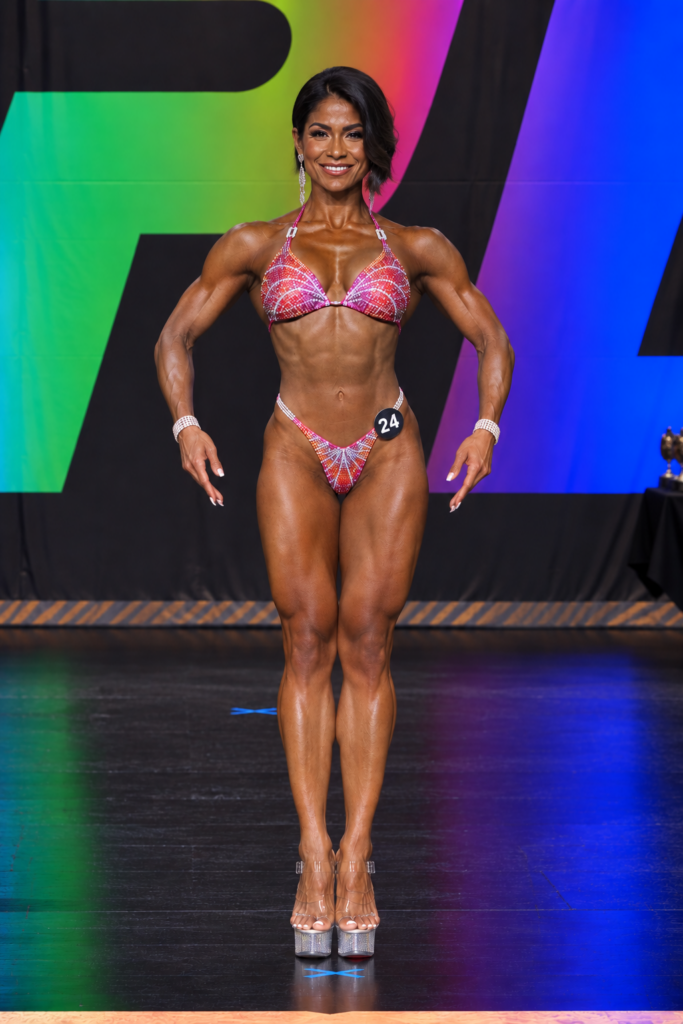
Figure athletes must wear a two-piece Figure competition suit. The suit must link the top and bottom via connectors in the back.
Suit straps must cross in the back, forming an X, as shown in the official IPL Figure posing examples.
Suits may be patterned and may have stones. Stones are recommended.
Jewelry and hair ornaments are allowed at Pre-Judging and Finals.
Presentation, including make-up and hair, is judged.
Clear Competition Heels. With or without stones. (no minimum or maximum heel height)
Posing
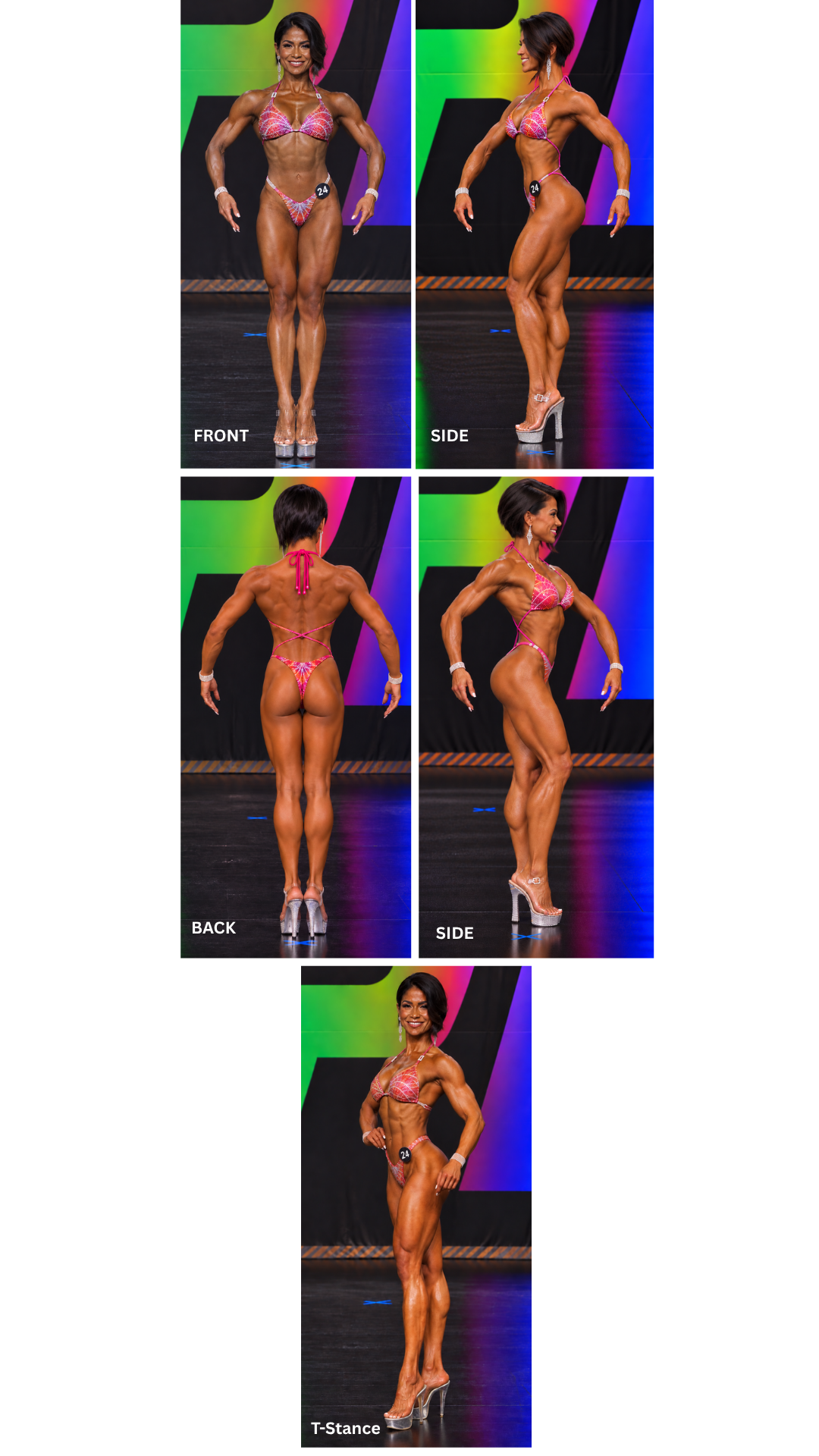
During the Front, Side, and Back poses, both arms should remain slightly away from the body, allowing the judges to clearly evaluate the athlete’s muscularity, symmetry, shape, and conditioning.
The elbows should have a natural bend and should not be locked or pulled tightly against the body.
Hands and fingers should remain relaxed and controlled. Do not make fists.
Arms may be naturally readjusted during transitions between poses.
FRONT POSE
The athlete should face the judges directly, with the shoulders, torso, hips, and feet square to the judges.
Both arms should be positioned slightly away from the body with a natural bend at the elbows.
The chest should remain elevated and the shoulders open, allowing the upper body and lat width to be clearly displayed.
Both legs should remain relatively straight and engaged to display the quadriceps, calves, and overall lower-body development.
Feet should remain relatively close together and point generally forward.
Do not substantially twist or rotate the hips or torso.
FIRST SIDE POSE
Quarter turn to the athlete’s right.
The athlete should present the body from the side while maintaining an upright, controlled posture.
Both arms should remain slightly away from the body with a natural bend at the elbows.
The chest should remain elevated and the shoulders open.
The forward leg should be bent naturally, with the opposite leg serving as the primary support leg.
The legs should be positioned to clearly display the quadriceps, hamstrings, glutes, and calves.
The athlete should not turn the head toward the judges.
BACK POSE
Quarter turn to the athlete’s right.
The athlete should face directly away from the judges, with the shoulders and hips square to the rear.
Both arms should remain slightly away from the body with a natural bend at the elbows.
The back should remain open and engaged to clearly display back width, muscular development, conditioning, and symmetry.
Both legs should remain relatively straight and engaged to display the glutes, hamstrings, and calves.
Athletes with long hair should move their hair to one side or otherwise position it so the back, shoulders, and waist remain clearly visible to the judges.
SECOND SIDE POSE
Quarter turn to the athlete’s right.
The athlete should present the opposite side of the body while maintaining an upright, controlled posture.
Both arms should remain slightly away from the body with a natural bend at the elbows.
The chest should remain elevated and the shoulders open.
The forward leg should be bent naturally, with the opposite leg serving as the primary support leg.
The legs should be positioned to clearly display the quadriceps, hamstrings, glutes, and calves.
The athlete should not turn the head toward the judges.
T-STANCE
The T-Stance is a mandatory Figure pose that may be requested by the Head Judge.
The athlete should stand in a three-quarter position, presenting both the front and side of the physique to the judges.
The back hand should be placed at the waist/hip, with the elbow presented outward.
The opposite arm should remain free and slightly away from the body with a natural bend at the elbow.
The free hand and fingers should remain relaxed. Do not make a fist.
The torso should remain upright with the chest elevated and the shoulders open.
The legs should be positioned to create a balanced presentation while clearly displaying the athlete’s lower-body shape and muscular development.
HAND AND WRIST POSITION
Hands and wrists should remain natural, relaxed, and controlled.
Fingers should remain relaxed rather than tightly clenched or formed into a fist.
Avoid exaggerated hand or wrist positions that distract from the physique.